


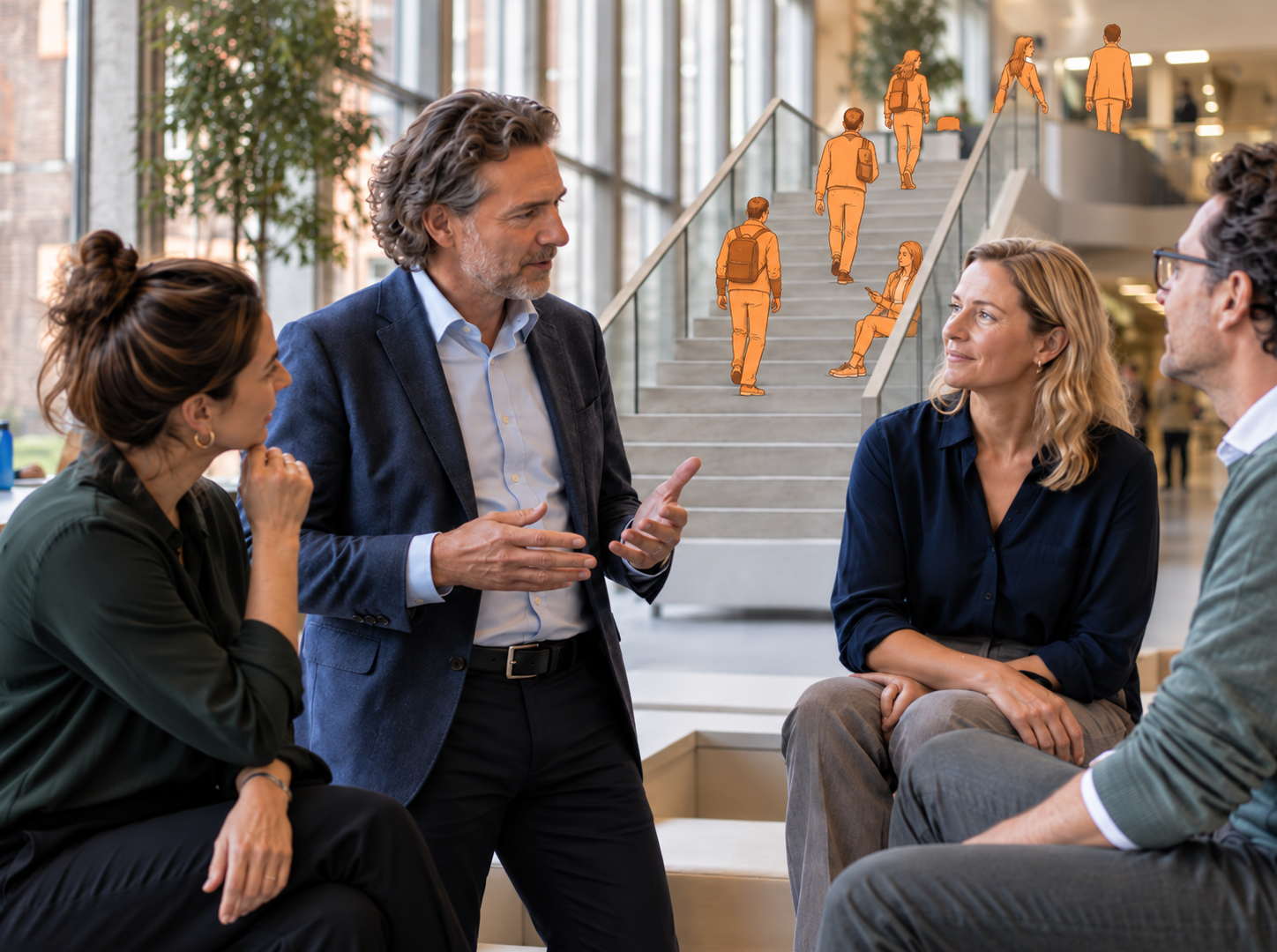
From HR assessment to a stronger human capital ecosystem
Share this post
Challenge
A large university had established a clear direction for its people and organisation through a new HR vision and a strategic HR programme. At the same time, challenges relating to a tight labour market, workload, social safety, talent development and employability were increasing.
The central question was whether the HR function was sufficiently equipped to deliver on these ambitions. In this highly decentralised organisation, HR had evolved organically, resulting in differences in roles, ways of working and levels of maturity across different parts of the university.
The review showed that strengthening HR alone would not be enough. The way HR, managers and the Executive Board worked together was also crucial. This broadened the assignment into a multi-year development programme, with particular attention to providing managers with better support, equipping them for their responsibilities and strengthening their position.
Approach
We began with a comprehensive review of the HR function. We examined HR at both central and local levels, differences between faculties and other parts of the university, and how they worked together. This gave us a clear picture of levels of maturity, challenges and underlying patterns.
We then supported the university in moving from analysis to development and implementation. We helped establish the governance arrangements and oversight of the improvement agenda, enabling central and local HR teams to take joint responsibility for further development.
This led to two areas of development. For HR, the emphasis was on further professionalisation, including developing HR advisers into stronger partners for line management, with a shared professional standard, feedback from across the organisation and practice-based development.
We also explored the challenges surrounding leadership in greater depth. Across the university, we examined how leadership was organised and what conditions, support and direction from the Executive Board were needed. Together with the Executive Board, deans, directors and department heads, we translated the findings into concrete decisions and areas for action to embed ‘people management’ more firmly across the organisation.
Impact
What began as a review of HR developed into a broader effort to strengthen people and the organisation. A shared understanding emerged of HR’s strengths and areas for development, alongside a joint improvement agenda and targeted development of HR advisory practice.
Good leadership also received greater attention at Board level. Concrete actions focus on clear leadership profiles, better selection, onboarding and development, stronger leadership networks and better conditions for managers.
The focus thus shifted from ‘how can we make HR stronger?’ to ‘how can we work together to strengthen the way HR, managers and the Executive Board interact?’ Together, they play a decisive role in realising the ambitions for people and the organisation.
Over de auteur

For a nationwide secondment and consultancy firm, we developed and implemented a new performance and development review cycle, career pathways and clearly defined HR processes, among other improvements.

We established a foundation of good employment practices and mutual responsibility between employer and employees. Rigid working relationships were transformed, enabling people to enjoy their work again and collaborate effectively.

A large national public sector organisation needed to realign its structure and governance with a new strategic direction. We worked to clarify responsibilities, enable more decisive decision-making and develop a coherent organisational plan.

By organising the HR function as a whole organisations can create an HR function that not only supports day-to-day operations but also makes a lasting contribution to organisational ambitions, job satisfaction and the development of human capital.